From Owensboro to Little Turtle: An Evening with Trey from Green River Distillery
The Central Ohio Whiskey Society welcomed Trey Watson, Ohio brand representative for Green River Distillery. It turned out to be an evening that was both fun and educational. Trey didn’t bring a polished slideshow or a rehearsed pitch. Instead, he worked the room table by table, sharing stories and keeping every glass full. By the end of the night, seven expressions had been poured. They ranged from an $18 everyday sipper all the way up to a true unfiltered cask strength bourbon. Plenty of members left already planning a trip to their nearest liquor store.
141 Years in the Making: The Story of Green River
Most bourbon presentations feature the usual suspects: big names, famous families, and storied counties. Green River is different. It’s the tenth oldest licensed distillery in Kentucky, with 141 years of continuous operation behind it. Trey was emphatic about what that means: no active American distillery has been making bourbon longer. Other brands have revived old labels or bought up historic names, but none have stayed in business the way Green River has.
That longevity earned Green River a rare distinction early on: around 1911 or 1913, it became the official whiskey of the United States military. Wounded Marines recovering in field hospitals weren’t just given medication — they were given Green River.
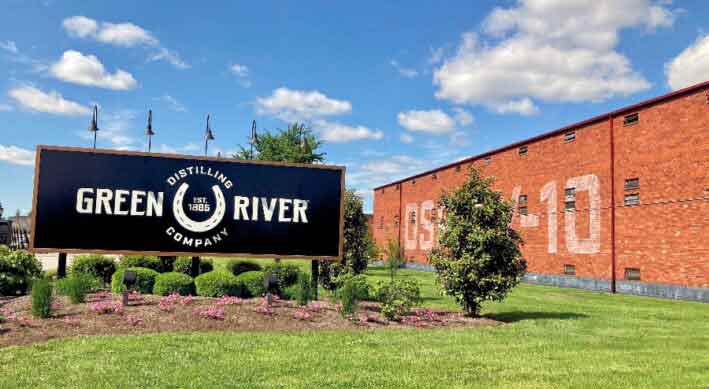
The distillery sits in Owensboro, Kentucky, about four hours from Columbus. Its warehouses have an interesting quirk: the rickhouses use clay tile siding, which creates natural air pockets that circulate air without any mechanical help. This likely wasn’t planned as a premium aging feature; it was probably just a cheap building material at the time. Still, the result is a distinctive aging environment. Some barrels actually absorb a small amount of water from the surrounding climate, rather than only losing it through evaporation. That’s a meaningful difference from most Kentucky operations, and it shapes Green River’s character.
What the Room Tasted: Seven Expressions, One Night
Trey framed the lineup early on. Nothing being poured was allocated, and nothing was hard to find under normal circumstances. The price ceiling for the night was fifty dollars a bottle. His goal was simple: show what Green River can do at prices that don’t require a raffle ticket to obtain.
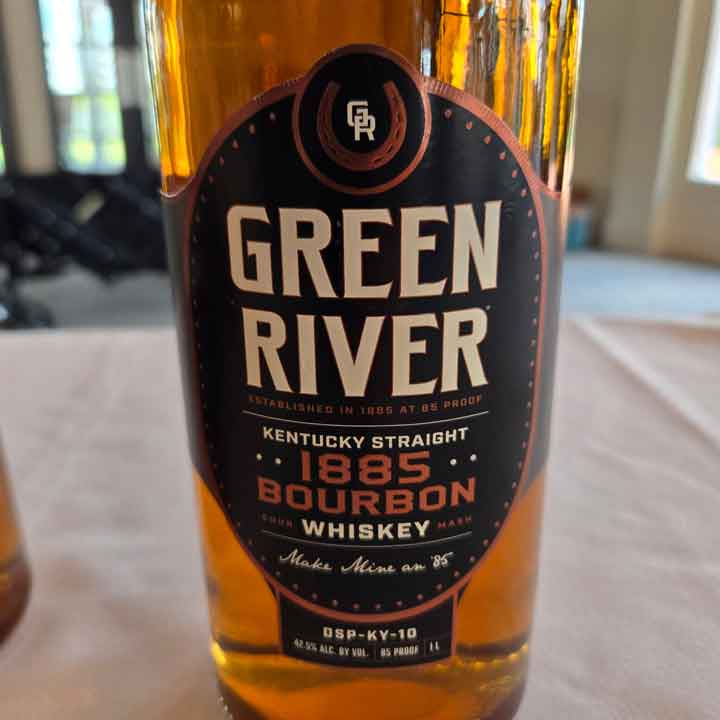
1885 Black Label — 85 proof
The first pour was a deliberate choice meant to set expectations early. Green River’s entry-level expression is named for the year the distillery was founded. Trey was refreshingly direct about what it is and isn’t: “This is not meant to be a great bourbon.” Instead, it’s their version of a well whiskey. Think the bottle behind the bar at a pool hall, or the one you crack open with your brother without ceremony. At roughly 45 cents an ounce, it’s built for accessibility rather than complexity.
Still, the room found that accessible doesn’t mean bad. The consensus at most tables was not bad at all for eighteen bucks. It’s easy-drinking, light, and inoffensive in the way the best well whiskeys are. Think of it as Green River’s answer to Jim Beam or Jack Daniel’s: simple, affordable, and reliable for a quick cocktail. In short, it does exactly what it’s supposed to do.
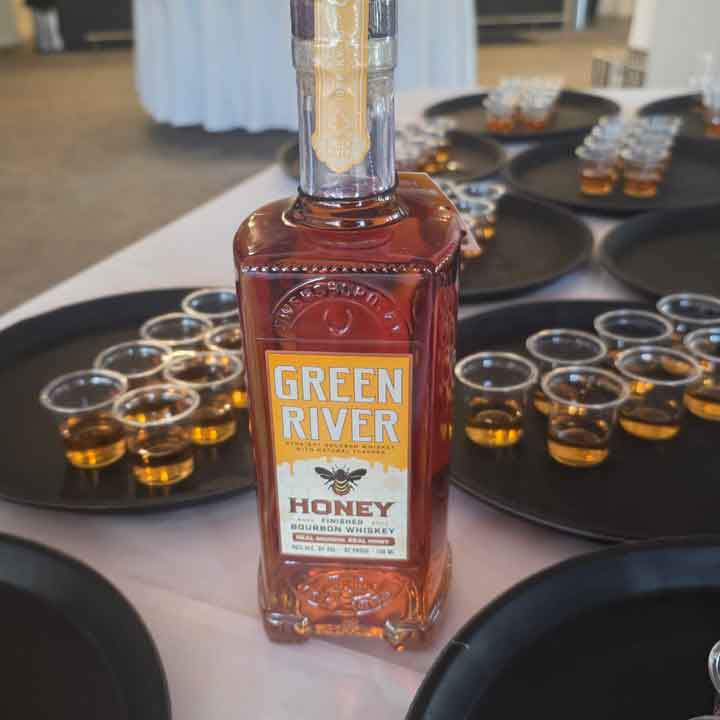
Green River Honey — 92 proof
The second pour was one Trey wasn’t sure would land. It ended up selling out his entire Ohio allotment in just two weeks.
The process behind it is simple but genuinely clever. Take an aging bourbon barrel, pull out 10 gallons of whiskey, and replace it with 10 gallons of Kentucky-sourced honey. Let everything mingle for six months, then blend it back together and proof it down to 92. There are no extracts and no artificial flavoring involved. It’s just bourbon and honey that have spent half a year together in the same charred oak barrel.
Trey described it as something genuinely new in the market. It’s not a candy-sweet shooter, but rather a legitimate sipping whiskey at a price ($25) that fits just as well at a campus party as it does at a serious tasting. At the time of the meeting, Ohio was sold out until mid-August. So if you spot a bottle, don’t wait around.
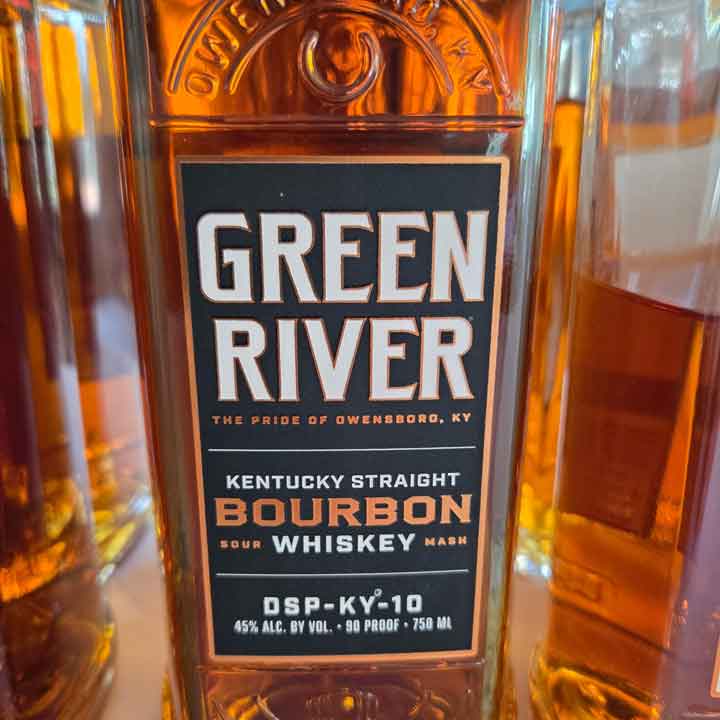
Kentucky Straight Bourbon — 90 proof
Green River’s flagship mash bill is an old one: 70% corn, 21% rye, and 9% malted barley. That’s the recipe the distillery was originally built on. The higher rye percentage puts this bourbon in the bold, spicy camp, though at 90 proof it remains approachable for most drinkers.
Trey used this pour to share an interesting piece of history. For decades, Green River quietly made wheated bourbon for other brands in the industry. Julian Van Winkle and others came to Green River specifically because nobody did wheated better. However, Green River never sold a wheated bottle under its own name, until Bardstown acquired the distillery and found those barrels sitting in the warehouse. Trey also mentioned the Army 250 commemorative bottle, a fitting tribute given Green River’s history as the official whiskey of the U.S. military. It may still be findable on some shelves.
At $35, this bottle is a dependable workhorse worth knowing.
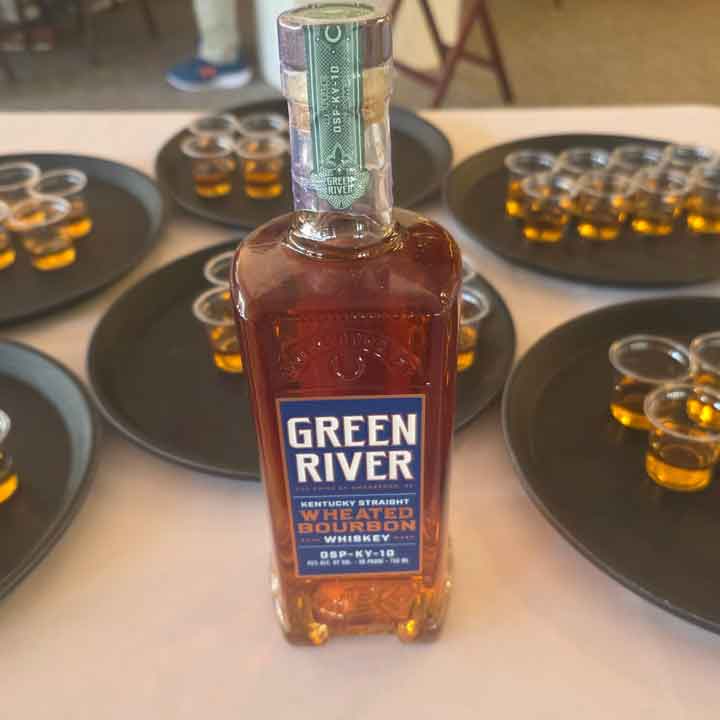
Kentucky Straight Wheated Bourbon — 90 proof
The fourth pour mirrored the third one closely. It uses the same 70% corn base and 9% malted barley, but swaps the rye for 21% wheat instead. The result is softer, sweeter, and lighter overall.
This happens to be Green River’s best-selling expression by a wide margin, and there’s good reason for that. Last year, the Green River Wheated Bourbon was named best bourbon in the world at the IWSC International World Spirits Competition.
This expression exists thanks to a happy discovery. After acquiring Green River, Bardstown found barrels of wheated bourbon that Green River had quietly been making for other brands for decades, including for Julian Van Winkle. Once those barrels turned up, releasing them under the Green River name was an easy call. Even better, existing contracts let Bardstown price it the same as the standard rye bourbon, even though wheat is typically a pricier flavor grain. The result is exceptional value that the market has clearly recognized.
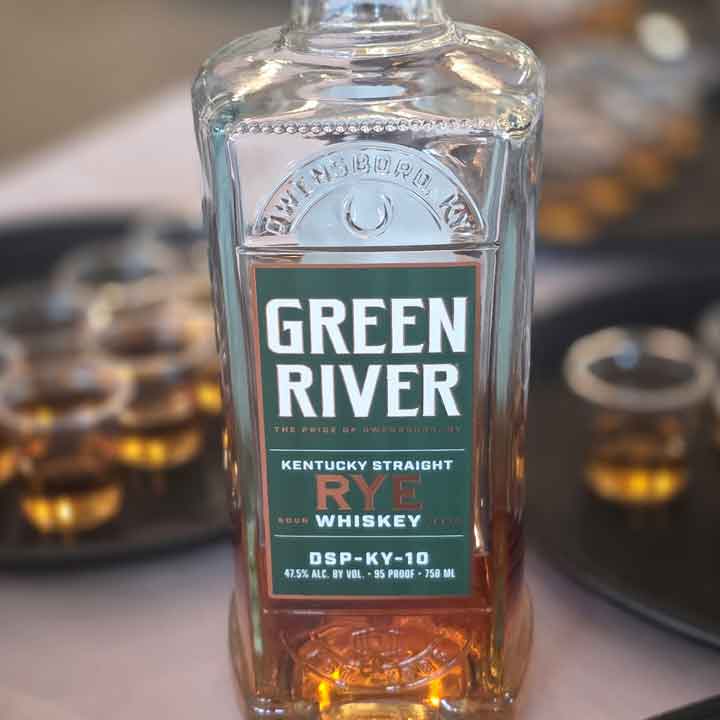
Kentucky Straight Rye Whiskey — 95 proof
The fifth pour was the only non-bourbon of the night, and Trey quietly admitted it’s his personal favorite.
Green River Rye uses the 95/5 mash bill, meaning 95% rye and 5% malted barley. This recipe, developed in the 1940s at what is now the MGP plant, has become the industry’s most widely used rye formula. Trey’s take on the category was blunt: if you’ve had a rye whiskey that wasn’t Jim Beam, there’s a good chance Bardstown or Green River made it somewhere along the way. Many brands buy this same young rye and charge $100 a bottle for it. Green River instead chose to age it to six years, release it at 95 proof, and price it at just $35.
This pour tends to be the spiciest of the night, since there’s no corn to soften things. Still, Trey noted that rye is often the category people assume they dislike, until they actually try a good one.
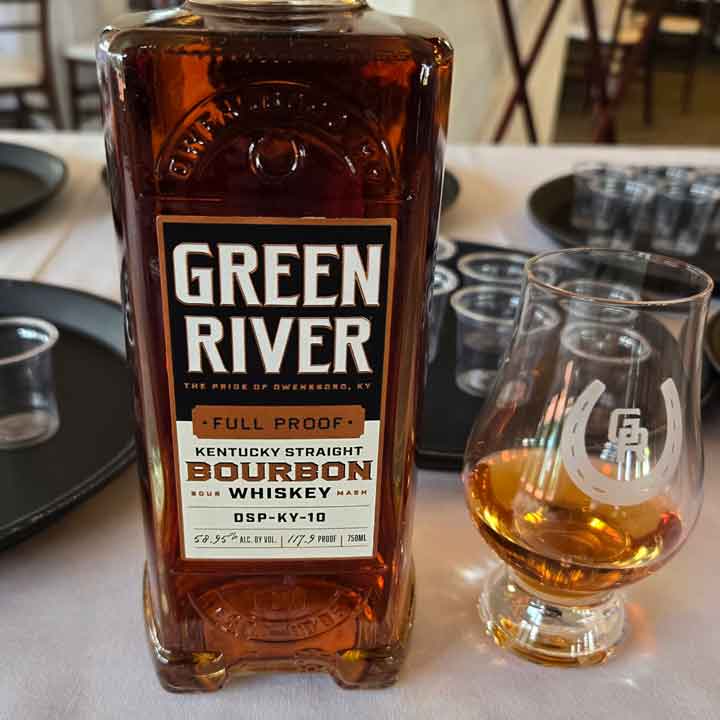
Full Proof Kentucky Straight Bourbon — 117.9 proof
The sixth pour brought back the Kentucky Straight Bourbon, this time fully uncut and unfiltered.
Trey used this pour to explain barrel aging in more depth than usual. Bourbon enters the barrel at 125 proof. Heat pushes the whiskey into the wood, while cold pulls it back out. Since water evaporates faster than alcohol, the proof inside the barrel tends to rise over time, often climbing past 130 proof at most Kentucky distilleries.
However, Green River’s Owensboro location runs cooler, and its clay tile rickhouses help buffer those temperature swings further. As a result, these barrels don’t spike the same way. In fact, they sometimes absorb a bit of water from the surrounding air. After seven years, this bourbon came out at 117.9 proof, and nothing has been added since. What comes out of the barrel goes straight into the bottle.
One side effect of skipping filtration is worth mentioning: small cloudy flakes may appear if the bottle sits for a while. Trey called this “flock,” a harmless protein that chill filtration would normally remove. It’s not a flaw at all. It’s simply what true, unfiltered bourbon looks like.
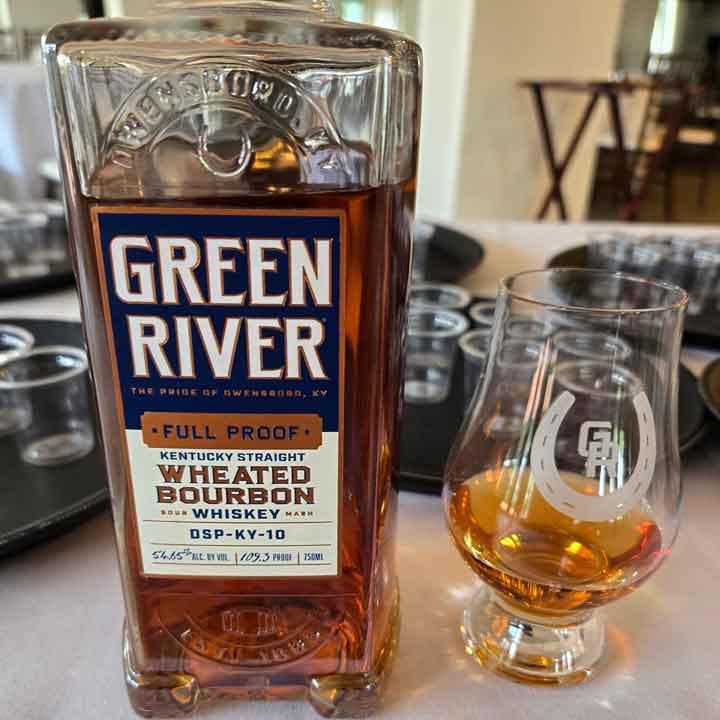
Full Proof Kentucky Straight Wheated Bourbon — 109.3 proof
The final pour closed out the evening with a cask strength version of the award-winning Wheated Bourbon. It’s also the newest high-proof release from Green River.
It shares the same 70/21/9 wheated mash bill as the standard version. So, this is essentially what happens when a bourbon that won best in the world gets bottled without any added water. Demand backs that up: it sold out across Ohio within its first month, with more expected back by mid-August.
Along the way, Trey explained why cask strength exists as a category in the first place. Back in the days of horse-drawn carriages, drinkers often got just one whiskey delivery a month. Naturally, they wanted the highest proof possible, since adding water at home effectively doubled their supply. In other words, cask strength began as a practical solution to a logistics problem, not as a flavor statement.
At $50, the Full Proof Wheated sits at the top of the Green River lineup. And if the rest of the evening was any indication, it’s a ceiling that’s hard to argue with.
A Brand Built for Fun
Green River takes its history seriously without taking itself too seriously. The horseshoe stamped on the bottom of every bottle traces back to an early-1900s legend: the distillery’s owner once traded five barrels of bourbon for a 10% stake in a California gold mine that turned out to be worth hundreds of millions today. His takeaway — if you got to drink Green River, you were lucky — became a horseshoe on the bottle. The resulting game, “shoot the shoe,” involves sliding a challenge coin under the upward-facing shoe for a free drink, and Trey hands out matching military-style coins at events.
One expression came up but wasn’t poured: a High Rye cask strength at 111.1 proof, timed for a November 11th (Veterans Day) release in honor of Green River’s military roots. Strong early performance led Ohio to order extra pallets, and Trey expects it on shelves around July 4th.
Thanks to Trey for an evening that was as instructive as it was entertaining. To track down Green River bottles, OHLQ’s site (ohlq.com) lets you search by zip code and will actually tell you where to find them.